Industrial equipment movers in Cibolo, TX need to do more than drive a big truck. They have to rig, skid, and set heavy machinery without damaging your floor, your equipment, or your production schedule. This guide breaks down what the work actually involves, what it costs, and the permits Texas requires before a load leaves your dock.
What Industrial Equipment Movers Actually Do
General moving companies pack boxes and load furniture. Industrial equipment movers rig machinery.
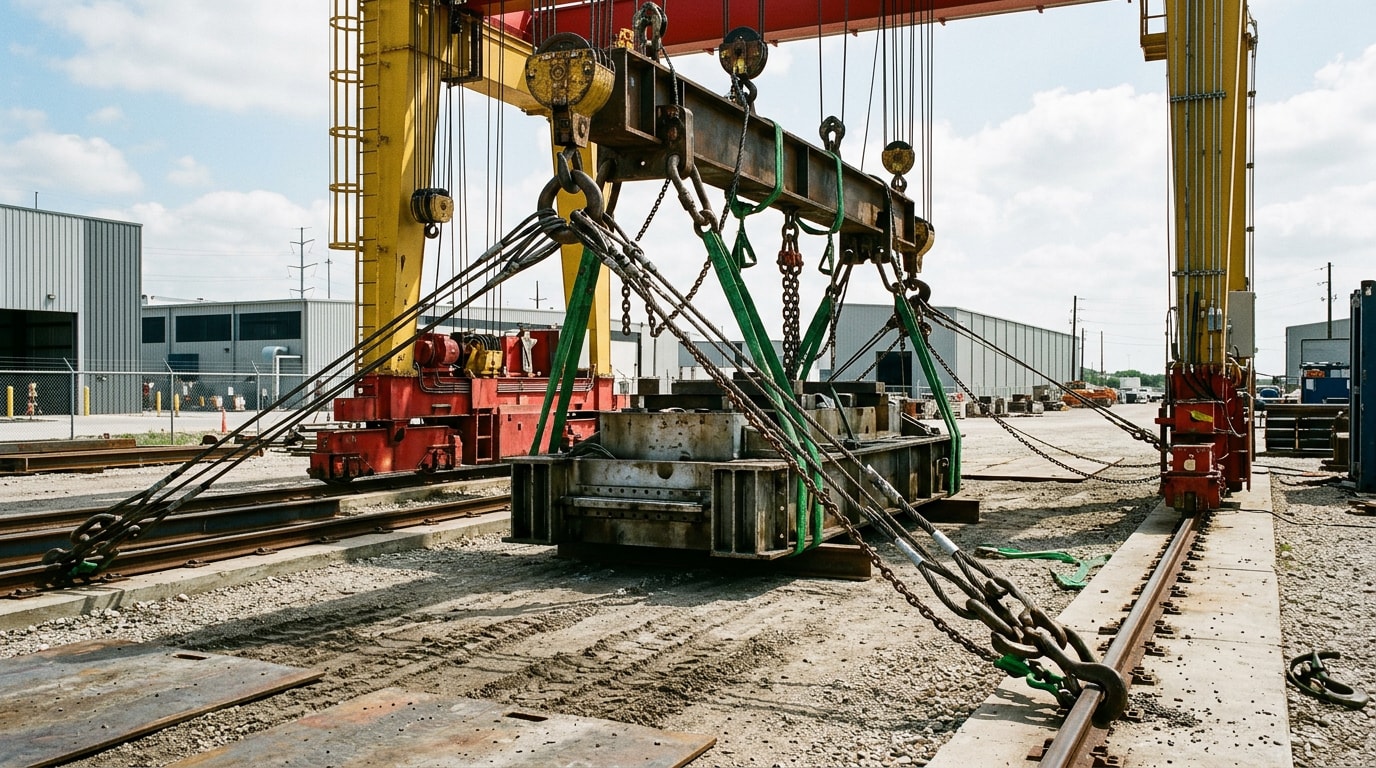
That difference matters once a job involves anything heavier than a few hundred pounds or wider than a standard doorway. Our crews specialize in:
- CNC machines and precision production equipment
- Hydraulic and mechanical presses
- Generators and transformers
- Conveyors and full production lines
- Millwright work, including precision alignment and engineered critical lifts
Every job starts with a site walk, not a truck. Our crew lead has spent more than a decade moving machinery across Central Texas plants, and that experience shows up in the small decisions, like which floor penetrations need protection boards before the skates ever roll, not after something cracks.
You can see examples of completed rigging and demolition-support jobs on our projects page, and the full company background is on the homepage.

Cost to Move Industrial Equipment in Cibolo, TX
Pricing depends on five variables: weight, dimensions, route complexity, floor conditions, and whether the machine needs dismantling or reinstallation.
The ranges below reflect what similar local and regional rigging jobs typically run. Treat them as a planning tool, not a quote.
| Weight Class | Local (under 30 mi) | Regional (30-150 mi) |
|---|---|---|
| Under 5,000 lbs | $500 - $1,500 | $1,500 - $3,500 |
| 5,000 - 20,000 lbs | $1,500 - $4,000 | $4,000 - $8,000 |
| 20,000+ lbs | $4,000 - $12,000+ | $8,000 - $20,000+ |
Site access and rigging complexity move the final number more than distance does. A machine on a second floor with a tight stairwell can cost more to move 200 feet than a comparable machine moved 30 miles on a flatbed. Request a free quote built around your specific equipment and site conditions.
Why Hire Certified Riggers Instead of General Movers
Lifting and relocating heavy, awkward equipment without the right tools and training is dangerous. This isn't a marketing line, it's federal regulation.
OSHA's rigging standard for material handling requires that rigging equipment for material handling be inspected prior to use on each shift, with defective equipment removed from service . That inspection discipline is baked into every lift our crews perform, not treated as optional paperwork.
Rigger qualification matters just as much as equipment condition. The National Commission for the Certification of Crane Operators offers two tiers of rigger credentials, and Rigger Level I covers identifying rigging components, performing inspections, and executing simple rigging activities, while Level II covers planning and performing complex rigging activities, including determining load characteristics and selecting appropriate components . A press or transformer move usually calls for Level II judgment, not just Level I task execution.
Working with insured, trained riggers protects three things at once: your equipment, your floor, and your production timeline. A botched DIY lift doesn't just risk injury, it risks weeks of downtime while a damaged machine gets repaired or replaced.
Permits for Oversized Loads Leaving Your Site
A lot of Cibolo facilities only think about permits when the machine is already strapped to the trailer. By then it's too late to fix a routing problem.
Vehicles or loads that exceed Texas legal size and weight limits must have an oversize/overweight permit and an authorized route, when applicable, issued by the TxDMV before traveling on Texas's public roadways. That applies to a lot of industrial equipment: wide presses, tall generators, and anything that pushes a flatbed past standard legal dimensions.
Before applying for a permit, you must know the exact dimensions and weight of your vehicle and load, since that information determines whether a permit is needed and which permit type applies. We handle this step as part of regional moves so it isn't a surprise on moving day.
If your project also involves clearing a pad or prepping a foundation for new equipment, our site preparation and skid steer services teams coordinate directly with the rigging crew so the two jobs don't collide on scheduling.
Our Cibolo, TX Service Area
We're based near the I-35 and I-10 industrial corridors, which puts most Guadalupe County job sites within easy reach for both planned moves and urgent rigging calls.
Primary coverage includes:
- Cibolo, TX and surrounding Guadalupe County communities
- San Antonio, TX metro
- Seguin, TX
- Schertz and Universal City
Beyond the core 30-mile radius, our teams take on plant relocations and engineered critical lifts across Central Texas when a project calls for it. If your move also involves transporting equipment a longer distance, our write-up on flatbed moving services for heavy equipment and machinery covers oversized load hauling in more depth.

FAQ
What are industrial machinery movers?
Industrial machinery movers are rigging specialists who use purpose-built tools, like machine skates, toe jacks, and rated forklifts, to move, skid, lift, and hoist heavy, complex equipment. The work often includes dismantling and reinstallation, and it demands real training because mishandling can cause serious injury or equipment damage.
How much does it cost to move industrial equipment?
Cost depends on weight, distance, floor conditions, and crating or dismantling needs. See the cost table above for typical ranges, or request a quote for an exact number based on your equipment.
Why hire professional machinery movers instead of a general moving company?
General movers aren't trained in rigging mechanics, load calculations, or OSHA inspection requirements for material handling equipment. Professional riggers bring that training to every lift, which protects your equipment, your crew, and your schedule.
What's the heaviest machine you can move?
Most jobs fall between roughly 2,000 and 100,000 pounds. Every heavy or tight-space move gets a lift plan before anyone touches the machine, regardless of tonnage, and anything above our standard capacity gets engineered on a case-by-case basis.
Do I need a permit to move industrial equipment on Texas roads?
If the load exceeds Texas's legal size or weight limits, yes. The TxDMV requires an oversize/overweight permit and sometimes an authorized route before the load can travel on public roads. We handle this paperwork as part of regional and long-distance moves.
Do you travel across Texas for machinery moving and rigging?
Yes. Based near San Antonio, our crews handle regional moves along the I-35 corridor and beyond, covering jobs statewide when oversized loads require special routing or permits.